
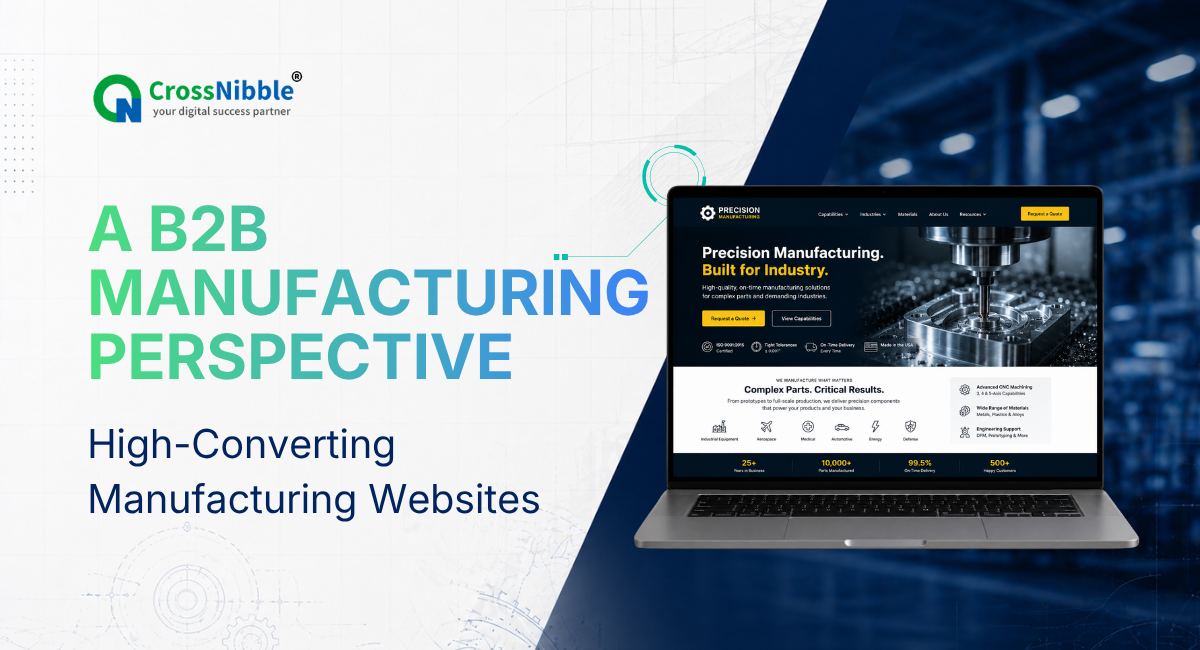
Most manufacturing companies do not have a traffic problem. They have a conversion clarity problem.
Across India, Europe, and North America, industrial websites often look impressive. They display infrastructure, certifications, plant images, export markets, and equipment lists. However, when evaluated from a buyer’s perspective, they lack structure, depth, and conversion intent.
A high-converting B2B manufacturing website is not built to impress visitors. It is built to guide serious decision-makers through evaluation.
That difference determines whether enquiries become qualified opportunities.
Understanding What Conversion Means in Industrial Markets
In B2B manufacturing, conversion does not mean instant purchase. It typically means:
- A technically relevant enquiry
- A request for detailed documentation
- A vendor evaluation discussion
- A project-based quotation request
- A sample or prototype inquiry
Conversion in this context means moving a serious buyer closer to engagement.
A high-converting industrial website is structured to support that progression logically.
It Begins with Sharp Positioning
Many manufacturing companies try to position themselves broadly. They describe themselves as leading manufacturers serving multiple industries without clearly defining where they are strongest.
A high-converting website clearly communicates:
- Which industries are primary focus areas
- What scale of production is supported
- Which compliance standards are maintained
- What types of projects are best suited
For example, there is a meaningful difference between saying:
“We manufacture precision components.”
And saying:
“We manufacture precision-machined components for automotive and industrial OEMs requiring ISO-compliant, export-ready production with repeat volume capability.”
The second statement filters the right enquiries and builds confidence among serious buyers.
Clear positioning improves enquiry quality.
It Speaks the Language of the Buyer
An R&D engineer evaluates suppliers differently from a procurement manager. A sourcing head in Germany reviews vendors differently from a domestic distributor in India.
A high-converting website addresses:
- Application environment
- Industry standards
- Performance parameters
- Compliance requirements
- Production reliability
Instead of using generic language such as “high quality fabrication solutions,” it explains measurable details such as tolerance levels, load-bearing capacity, corrosion resistance standards, or testing methods used.
Industrial buyers respond to technical clarity. Specific information signals competence.
Product Pages Are Structured Around Application Relevance
Most manufacturing product pages list specifications. While technical data is necessary, it does not answer decision-making questions.
A strong product page includes:
- Typical application use cases
- Industry segments served
- Compliance standards
- Performance advantages
- Customization capability
- Production scale readiness
For example, instead of simply listing stainless steel grades, the page should explain which grade performs better in chemical exposure environments or coastal humidity conditions.
Application context builds credibility.
It Builds Authority Through Operational Transparency
Authority in industrial markets is built through process maturity and documentation depth.
A high-converting website demonstrates:
- Case studies with real-world applications
- Process workflows
- Quality inspection checkpoints
- Testing lab capabilities
- Certification scope explanation
- Export experience
For global buyers, especially in Europe and North America, compliance readiness and documentation clarity are essential. If your website demonstrates structured operations, it reduces perceived risk during vendor evaluation.
Risk reduction directly improves conversion probability.
It Includes Industry-Focused Pages
Manufacturers often serve multiple sectors such as automotive, aerospace, heavy engineering, pharmaceuticals, or renewable energy.
A high-converting website creates dedicated industry sections rather than grouping everything under one services page.
Each industry page addresses:
- Sector-specific challenges
- Regulatory considerations
- Performance requirements
- Relevant case examples
- Typical order patterns
This improves both search visibility and buyer confidence.
When a buyer sees content aligned to their industry, they perceive specialization rather than generic capability.
It Supports the Sales Process with Structured Qualification Signals
Many manufacturing websites rely on simple contact forms that collect name, company, and message. This creates additional burden on the sales team because every enquiry must be manually qualified.
A more effective approach gathers contextual information without asking intrusive commercial questions.
Industrial buyers rarely disclose budget or firm timelines in initial contact. Especially in India, buyers often initiate conversations while evaluating multiple vendors. Globally, procurement teams avoid revealing commercial parameters until technical validation is complete.
Therefore, intelligent qualification focuses on operational context, not sensitive data.
Structured fields can include:
- Industry category
- Application type
- Product or component category
- Order type such as prototype, batch production, or recurring supply
- Estimated volume range bracket
- Geographic market
When integrated into CRM, this contextual data helps segment enquiries, prioritize opportunities, and recognize serious sourcing patterns.
Qualification becomes structured rather than reactive.
It Integrates with CRM and Tracks Buyer Behavior
A high-converting website does not operate independently from sales operations.
Form submissions should feed into CRM automatically. Sales interactions should be logged with structured fields. Follow-up status should be trackable.
Behavioral data matters.
If a prospect repeatedly visits a specific product page, downloads a technical document, and spends time reviewing compliance sections, that behavior indicates evaluation interest even if commercial details are not disclosed.
Intent is often revealed through digital interaction patterns rather than explicit declarations.
It Uses Layered Engagement Pathways
Not every visitor is ready to request a quotation.
A structured website provides multiple engagement options such as:
- Download technical brochure
- Request sample
- Ask technical question
- Schedule capability discussion
- Subscribe for industry updates
This layered approach captures different stages of buying intent and builds a pipeline over time.
It Communicates Scale and Reliability Clearly
Industrial buyers want confidence in production consistency.
A strong website communicates:
- Monthly production capacity
- Machinery capability
- Lead time range
- Export markets served
- Quality management systems
- Redundancy and contingency measures
Specific operational clarity builds trust faster than branding statements.
It Aligns Usability with Credibility
Industrial websites should prioritize clarity over visual decoration.
- Logical navigation
- Clear information hierarchy
- Structured technical content
- Fast loading speed
- Mobile responsiveness
Many procurement professionals review supplier websites on mobile devices while traveling or during factory assessments. Usability directly influences perceived professionalism.
It Supports Global Discoverability
For manufacturers targeting international markets, visibility matters.
- Industry-specific search queries
- Technical keyword ranking
- Structured schema markup
- International SEO best practices
- Page performance standards
When combined with authority depth, discoverability drives qualified inbound enquiries.
From Brochure to Revenue Infrastructure
A high-converting B2B manufacturing website is built around:
- Clearly defined ideal customer profile
- Industry-specific positioning
- Authority proof architecture
- Structured qualification pathways
- CRM integration
- Behavioral tracking
This transforms the website from a static digital presence into a pre-sales qualification system.
It does not simply increase enquiries. It improves relevance, reduces wasted effort, and shortens evaluation cycles.
Final Perspective
In industrial markets, growth is built on clarity, credibility, and structured systems.
A well-designed website functions as your first technical presentation to potential buyers across India and global markets. It communicates competence before any sales conversation begins.
Manufacturers that treat their website as revenue infrastructure consistently generate more structured opportunities than those who treat it as a branding formality.
If your website is not producing consistent, high-intent enquiries, the issue is not demand. It is structure.
And the structure can be redesigned.