
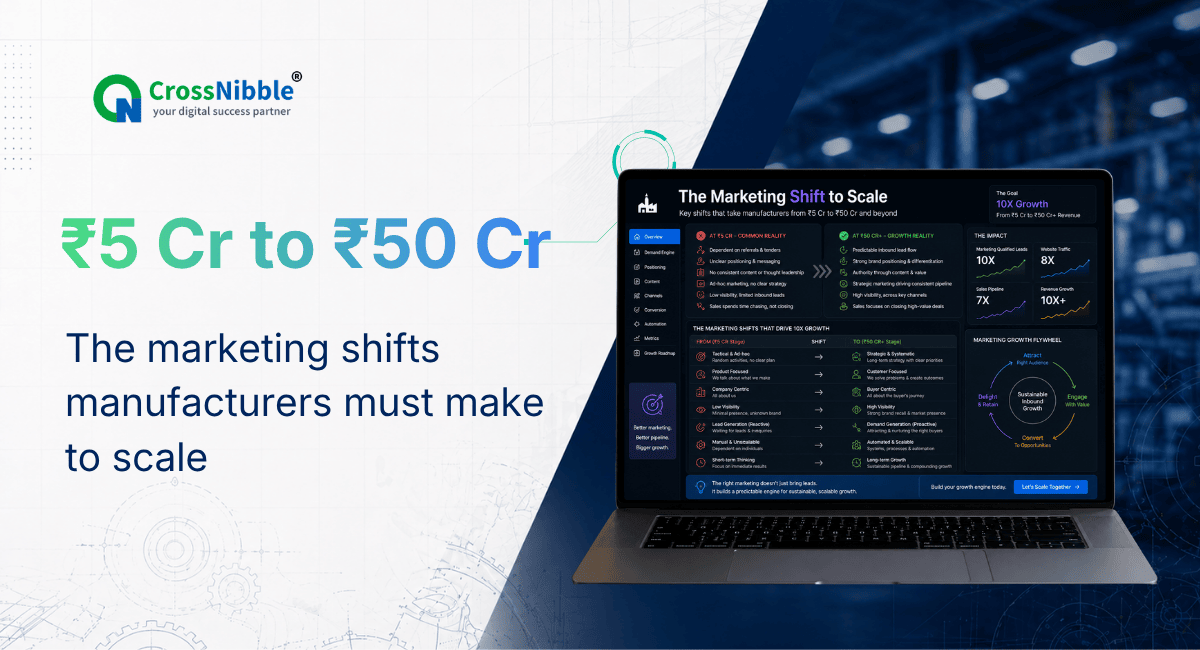
Many manufacturing companies grow from ₹1–5 crore through relationships, founder involvement, and operational excellence.
However, the journey from ₹5 crore to ₹50 crore requires structural shifts.
At smaller scale:
- Growth is relationship-driven
- Founder drives sales personally
- Referrals sustain revenue
- Marketing is minimal
At larger scale:
- Revenue must become system-driven
- Sales must be process-led
- Visibility must expand beyond networks
- Brand authority must support expansion
The marketing strategy that helped reach ₹5 crore will not support ₹50 crore growth.
The first shift: from relationship dependence to market positioning
At early stages, most deals come from:
- Founder network
- Distributor relationships
- Industry referrals
This creates comfort but limits expansion.
At ₹50 crore scale, growth requires visibility beyond existing relationships.
Required shift
Move from:
“We are known in our circle”
to
“We are positioned clearly in our target industries.”
This involves:
- Defined industry focus
- Structured digital authority
- Industry-specific case studies
- SEO aligned to high-intent segments
Positioning replaces dependence.
The second shift: from generic capability to specialized authority
At ₹5 crore, broad service offerings may work.
At ₹50 crore, specialization builds margin strength.
Manufacturers must clearly communicate:
- Core industries
- Core strengths
- Compliance advantages
- Production scale capability
Trying to appear capable of everything reduces perceived expertise.
Required shift
Prioritize high-margin segments.
Structure website, content, and marketing around:
- High-growth industries
- Repeat order potential
- Strong compliance readiness
- Export-oriented segments
Clarity increases scalability.
The third shift: from brochure website to revenue infrastructure
Small companies treat websites as credibility markers.
Growing companies must treat websites as qualification engines.
At ₹50 crore ambition, website should:
- Attract high-intent buyers
- Filter low-value enquiries
- Capture structured qualification data
- Integrate with CRM
- Support sales with case studies
The website must actively support pipeline creation.
The fourth shift: from reactive sales to pipeline visibility
At smaller scale, sales activity may rely on immediate opportunities.
At larger scale, forecasting becomes critical.
Leadership must know:
- Industry-wise pipeline distribution
- Conversion rates by segment
- Average deal size
- Sales cycle duration
- Repeat order frequency
Without structured CRM and qualification systems, scaling becomes risky.
Marketing must support predictable enquiry generation aligned with revenue goals.
The fifth shift: from event-based marketing to continuous visibility
Trade shows, exhibitions, and industry events remain important.
However, event-based spikes cannot sustain consistent growth.
At scale, marketing must operate continuously through:
- SEO
- Industry content
- Targeted outreach
- Export visibility
- CRM-driven nurturing
Continuous visibility builds steady enquiry flow.
The sixth shift: from local reach to geographic expansion
₹5 crore businesses often operate within limited geographic reach.
₹50 crore growth often requires:
- Multi-state expansion
- Export market penetration
- Diversification of buyer geography
Digital presence must reflect this ambition.
Website content should include:
- Export compliance details
- International case studies
- Global certifications
- Country-specific relevance
Geographic expansion requires structured visibility.
The seventh shift: from marketing as expense to marketing as investment
At an early stage, marketing is often viewed as cost.
At the growth stage, marketing must be treated as infrastructure investment.
This includes:
- Authority-building content
- Technical SEO
- CRM integration
- Conversion architecture
- Data-driven reporting
Return on marketing investment becomes measurable through:
- Qualified enquiry growth
- Industry penetration
- Improved conversion rates
- Repeat order increase
The role of leadership mindset
Scaling from ₹5 crore to ₹50 crore requires leadership to:
- Embrace data-driven decision-making
- Invest in digital authority early
- Align sales and marketing structurally
- Focus on long-term brand credibility
- Prioritize high-margin segments
Mindset determines structure.
Structure determines scale.
The global competitive context
Manufacturers competing globally must signal:
- Compliance maturity
- Production scale
- Process discipline
- Reliability
Digital visibility increasingly influences vendor shortlisting.
Companies aiming for ₹50 crore growth cannot rely solely on personal networks.
They must become discoverable, credible, and structured.
Final perspective
Growth from ₹5 crore to ₹50 crore is not linear expansion.
It is a structural transformation.
The required marketing shifts include:
- Clear positioning
- Specialization
- Revenue-focused website design
- CRM-driven qualification
- Continuous digital visibility
- Geographic expansion
Manufacturers who adopt these shifts build predictable growth engines.
Those who rely on early-stage methods often plateau.
Scaling is not about doing more of the same.
It is about building systems that support larger ambition.