
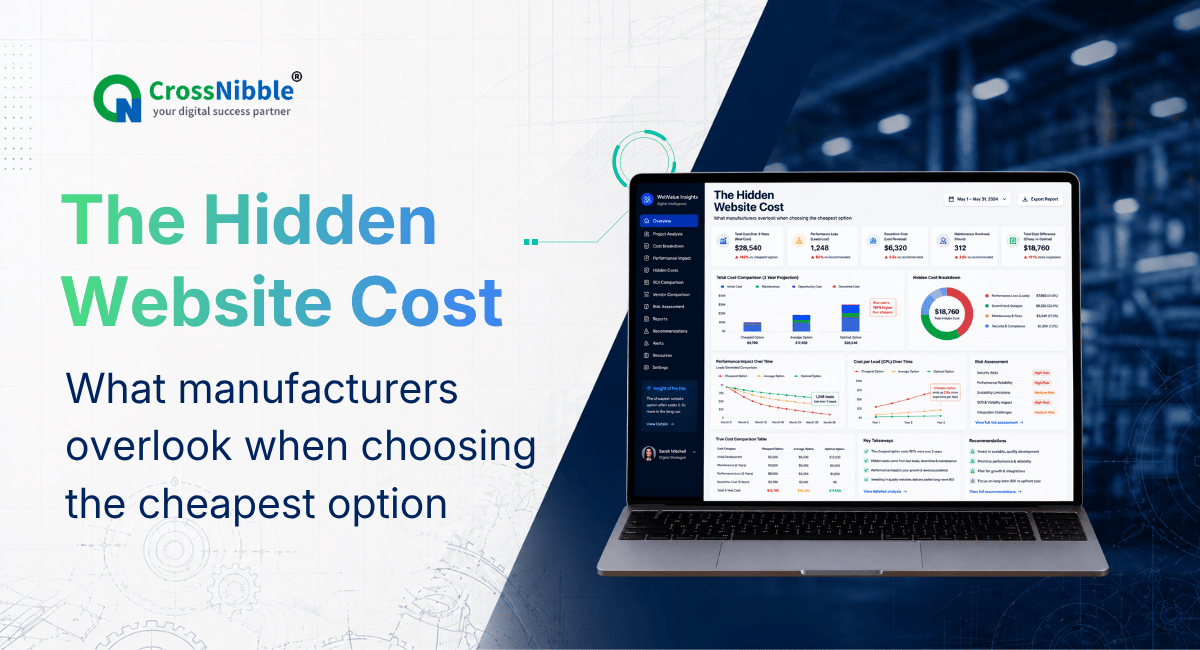
Many manufacturing companies treat website development as a one-time expense.
The typical decision framework looks like this:
- Get a website built quickly
- Keep costs low
- Add basic product pages
- Include a contact form
- Consider it complete
At that moment, it feels like a cost-saving decision.
However, over the next three to five years, that “cheap” website quietly becomes one of the most expensive growth mistakes.
Not because of hosting costs.
Because of lost opportunity.
The illusion of cost savings
When a company chooses a low-cost website, the visible savings are immediate.
For example:
Spending ₹50,000 instead of ₹1.5 lakh feels efficient.
However, this comparison ignores the revenue impact of:
- Weak positioning
- Poor conversion structure
- No SEO foundation
- No CRM integration
- No industry segmentation
The real cost is not the development fee.
It is the pipeline gap created by structural weakness.
Where cheap websites create hidden losses
1. Generic positioning limits high-value enquiries
Low-cost websites often include generic messaging such as:
Leading manufacturer
High quality products
Serving global clients
This language does not differentiate.
Serious buyers evaluating multiple suppliers do not shortlist based on generic claims.
The long-term cost
High-margin segments may never enquire because relevance is unclear.
The company continues attracting price-sensitive buyers instead of strategic clients.
2. No structured industry pages
Many inexpensive websites group everything under “Products.”
There is no industry-focused segmentation.
The long-term cost
Search visibility remains weak for industry-specific queries.
Buyers searching for compliance-ready or application-specific suppliers do not discover the company.
3. Weak conversion architecture
Cheap websites typically rely on a single generic contact form.
No structured qualification. No layered engagement. No behavioral tracking.
The long-term cost
Sales teams spend time qualifying low-potential enquiries.
High-intent prospects may not find relevant engagement pathways.
4. No SEO architecture foundation
SEO is often treated as an add-on rather than a structural design element.
Low-cost builds frequently lack:
- Keyword mapping
- Proper page hierarchy
- Internal linking strategy
- Schema markup
- Technical performance optimization
The long-term cost
When the company later decides to invest in SEO, major restructuring becomes necessary.
The initial “savings” disappear.
5. No CRM integration
Basic websites often send enquiries to email only.
There is no automated CRM integration or structured data capture.
The long-term cost
- Lead source tracking becomes unclear
- Qualification data is inconsistent
- Follow-up accountability is weak
- Revenue attribution is impossible
6. Design without revenue strategy
In many cases, inexpensive websites focus primarily on visual appearance.
Industrial buyers prioritize clarity, structure, and credibility.
The long-term cost
The website looks acceptable but fails to function as a qualification engine.
The compound cost of lost visibility
Consider this scenario.
If a manufacturer loses just one mid-sized export client per year due to weak digital credibility, the revenue loss may exceed several lakhs.
Over five years, the cumulative impact far outweighs the difference between a low-cost and strategically built website.
Opportunity costs compound quietly.
Why rebuilding later is more expensive
When companies eventually realize limitations, they often require:
- Complete repositioning
- Industry page restructuring
- Case study documentation
- SEO foundation redesign
- CRM integration
- Conversion pathway rebuild
Rebuilding costs significantly more than building correctly the first time.
What a strategic website investment includes
A properly structured manufacturing website includes:
- Clear ideal customer profile positioning
- Industry-specific architecture
- Application-led product pages
- Structured conversion pathways
- CRM integration
- SEO foundation
- Authority content strategy
This is not design alone.
It is revenue infrastructure.
The leadership perspective
From a leadership standpoint, the question should not be:
“How much does the website cost?”
It should be:
“What revenue capacity does the website enable?”
If the website contributes to:
- Higher-quality enquiries
- Faster evaluation cycles
- Better industry penetration
- Export expansion
- CRM intelligence
It becomes a strategic asset rather than an expense.
The competitive reality
Global buyers evaluate suppliers digitally before initiating conversations.
If your digital presence appears shallow compared to competitors, you may never enter the shortlist.
In industrial markets, credibility influences shortlisting.
Shortlisting influences revenue.
Final perspective
Cheap websites are rarely expensive because of what they cost upfront.
They become expensive because of what they fail to generate.
In B2B manufacturing, digital infrastructure is no longer optional.
It influences discoverability, credibility, qualification, and pipeline visibility.
Companies that invest strategically early build stronger growth foundations.
Those that postpone structure often spend more correcting mistakes later.
In growth-oriented manufacturing businesses, the website should not be treated as a brochure.
It should be treated as long-term revenue infrastructure.