
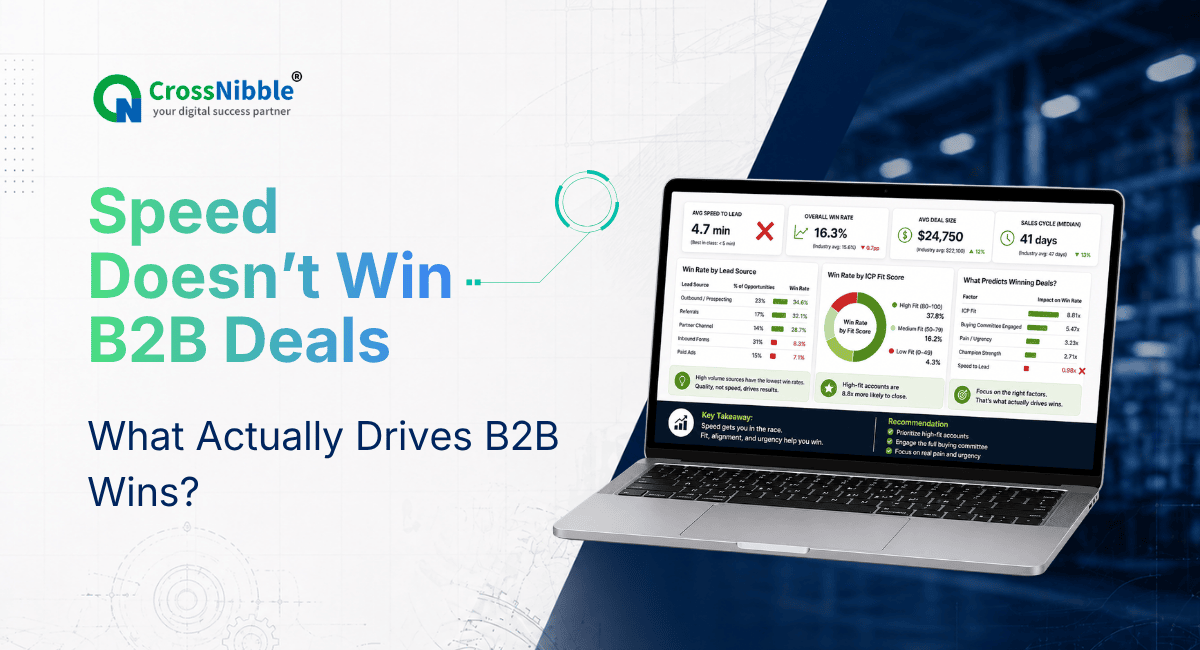
Cutting first-response time from hours to minutes does not lift B2B win rate. The data has been clear about this for years and most sales leaders still spend tooling budget on the wrong lever.
The variable that actually moves outcomes is engagement breadth. Won deals are not faster than lost deals. They are wider.
Quick answer: Speed-to-lead does not correlate with B2B win rate in long-cycle deals. Won deals receive 3 to 4 times more emails, engage 3 to 5 times more stakeholders, and pull in 3 to 4 times more internal people from the seller's side than lost deals. Optimise for engagement depth, not response speed.
Does Speed-to-Lead Actually Matter in B2B Sales?
In B2B with sales cycles longer than 60 days, speed-to-lead does not predict whether a deal wins or loses. When you compare won deals to lost deals across a few hundred opportunities, the response-time gap between them is statistically negligible. Both groups get answered at roughly the same speed. Only one group closes.
This contradicts the most cited research on the subject, the Harvard Business Review piece that said responding within five minutes increases your odds nine times. The original study was conducted on transactional and SMB sales motions. It does not generalise to B2B with a 158-day median cycle. The first response is one of forty touchpoints. Whether it happens in five minutes or four hours has minimal impact on what happens in month three when procurement gets involved.
What Actually Predicts B2B Sales Wins?
Four engagement metrics consistently separate winners from losers in long-cycle B2B.
- Email volume per deal: won deals get three to four times more
- External stakeholders engaged: won deals involve three to five times more
- Internal contributors from the seller side: won deals pull three to four times more
- Cadence consistency: won deals show steady weekly touch, not a fast initial burst
The pattern holds across industries, deal sizes, and rep skill levels. Engagement breadth is what moves outcomes.
Why Do Sales Teams Over-Invest in Response Time?
Three reasons that are easy to spot once you know what to look for.
1. The HBR Research Is Widely Cited
Most sales leaders read the headline and missed the methodology.
2. Response Time Is Easy to Measure
A KPI that is easy to measure usually wins over a KPI that is harder to measure, even when the easy one is wrong.
3. Tooling Vendors Push the Narrative
Response-time tooling is heavily marketed by sales-engagement vendors who profit from the assumption holding up. Most CROs adopt the tool because it is on their peer's roadmap, not because they ran their own data.
When Does Response Speed Matter in B2B?
It matters within active deals once they are multi-threaded. A reply to a CFO 24 hours after a discovery call is more valuable than a reply to a generic web form in five minutes. Speed matters for the response that maintains deal momentum, not the response that initiates a low-intent contact.
Translation: If you bought a sales-engagement platform for first-response SLA, repurpose it for active-deal SLA. The tool is fine. The use case is wrong.
How Do You Build a B2B Motion Around Engagement Breadth?
Codify Multi-Threading as a Deal-Stage Gate
No deal advances to proposal stage without four identified stakeholders mapped by role:
- Technical user
- Technical evaluator
- Economic buyer
- Procurement contact
The rep can request exceptions. The default is multi-threaded.
Track Stakeholder Count in the CRM
Make it a required field at each stage transition. Reps who cannot name four contacts at a Stage 3 deal do not have a Stage 3 deal.
Coach to Engagement, Not Activity
Replace activity metrics like calls per day and emails sent with engagement metrics like stakeholders touched per week and internal team members pulled in per deal.
The first set rewards motion. The second set rewards outcome.
Key Takeaways
- Speed-to-lead does not predict wins in long-cycle B2B.
- Engagement breadth (stakeholders, emails, internal team) does.
- Multi-threading should be a deal-stage gate, not a coaching suggestion.
- Response SLA matters inside active deals, not at top of funnel.