
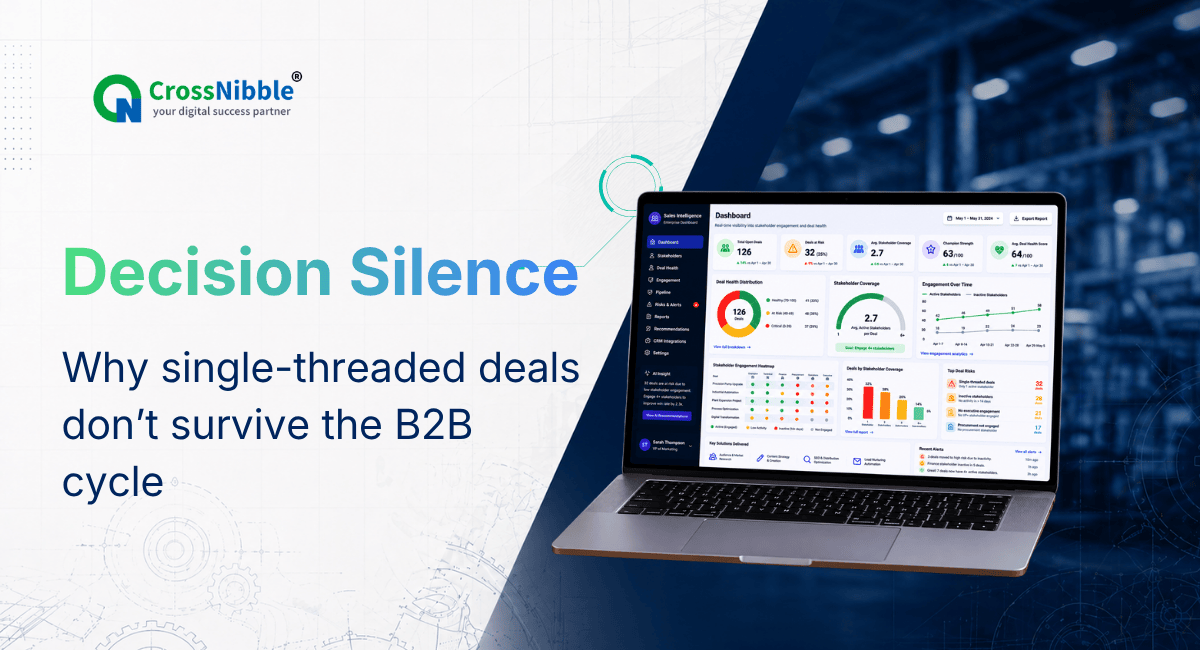
A single contact at a target account is not a deal. It is a placeholder for a deal that might exist if you do the work to find the rest of the buying committee. Most B2B reps know this. Most B2B sales processes do not enforce it. The gap between knowing and enforcing is where revenue dies.
Quick answer: Multi-threading is the practice of engaging multiple stakeholders within a target account during a sales pursuit. B2B won deals typically engage 4 to 6 external stakeholders and pull in 7 to 9 internal contributors from the seller side. Single-threaded deals lose at structurally higher rates.
What is multi-threading in B2B sales?
Multi-threading is the deliberate engagement of multiple stakeholders within a single target account during a sales cycle. The opposite is single-threading—working a deal through one contact regardless of how many people inside the buying organisation actually influence the decision.
In B2B, single-threading is structurally fragile. The champion leaves. Procurement gets involved late. The technical evaluator surfaces an objection nobody saw coming. The economic buyer goes silent. Each failure mode is invisible until the deal is lost.
Why do single-contact B2B deals fail?
There are four predictable failure modes:
- The champion leaves the company and the deal dies
- Procurement gets involved late and rejects the price because nobody prepared them
- Technical evaluation surfaces a concern the rep did not know existed
- The economic buyer goes silent because the deal was not as live as the rep believed
None of these are predictable from rep activity logs. They become visible only after the deal is lost. The rep blames the customer. The customer blames internal politics. Nobody learns anything. The same failure mode shows up on the next deal.
How many stakeholders should you engage per deal?
In aggregate B2B data, won deals consistently engage:
- 4 to 6 external stakeholders, mapped by role
- 7 to 9 internal contributors from the seller side
Lost deals typically involve only 1 to 2 stakeholders on each side. The pattern is consistent across industries and deal sizes.
What four roles must you identify per account?
Technical Champion
The person who actually uses the product—Lab Manager, Engineering Lead, R&D Scientist, QA Manager. They define what implementation looks like.
Economic Buyer
The signing authority—VP, Director, Plant Head. They control the budget.
Procurement Gatekeeper
The owner of the purchase process—Procurement Head, Purchase Manager. Critical in larger accounts where procurement is the bottleneck, especially in Indian PSUs and large MNCs.
Technical Evaluator
The validator who can quietly kill deals—Application Specialist, Senior Engineer. They may not appear in your CRM but strongly influence the decision.
How do you operationalise multi-threading?
Make it a deal-stage gating criterion, not a coaching suggestion.
- Stage 1 (Qualified): One stakeholder confirmed. Allowed.
- Stage 2 (Discovery Complete): Two stakeholders, including a confirmed economic buyer or path to one. Required to advance.
- Stage 3 (Proposal): Four stakeholders mapped by role.
- Stage 4 (Negotiation): All four roles engaged in the last 30 days. Otherwise, the deal moves back to Stage 3.
Deals that cannot meet these thresholds are not automatically bad deals. But they are not at the stage the rep claims, and your forecast becomes more accurate when you start enforcing this.
How do you handle rep pushback?
The most common pushback: “My contact will be offended if I go around them.”
The reality: In mature B2B sales motions, single-point-of-contact selling is a red flag for buyers, not a courtesy. Buyers expect to be multi-threaded. Champions appreciate it because it spreads political risk. Reps who resist multi-threading often have weaker champion relationships, not stronger ones.
Show reps the win-rate data from their own deals. Most respond to evidence from their own pipeline.
Key Takeaways
- Single-contact B2B deals are structurally fragile
- Won deals engage 4 to 6 external stakeholders and 7 to 9 internal contributors
- Multi-threading should be a deal-stage gate, not a coaching suggestion
- Forecast accuracy improves when stage transitions enforce stakeholder count