
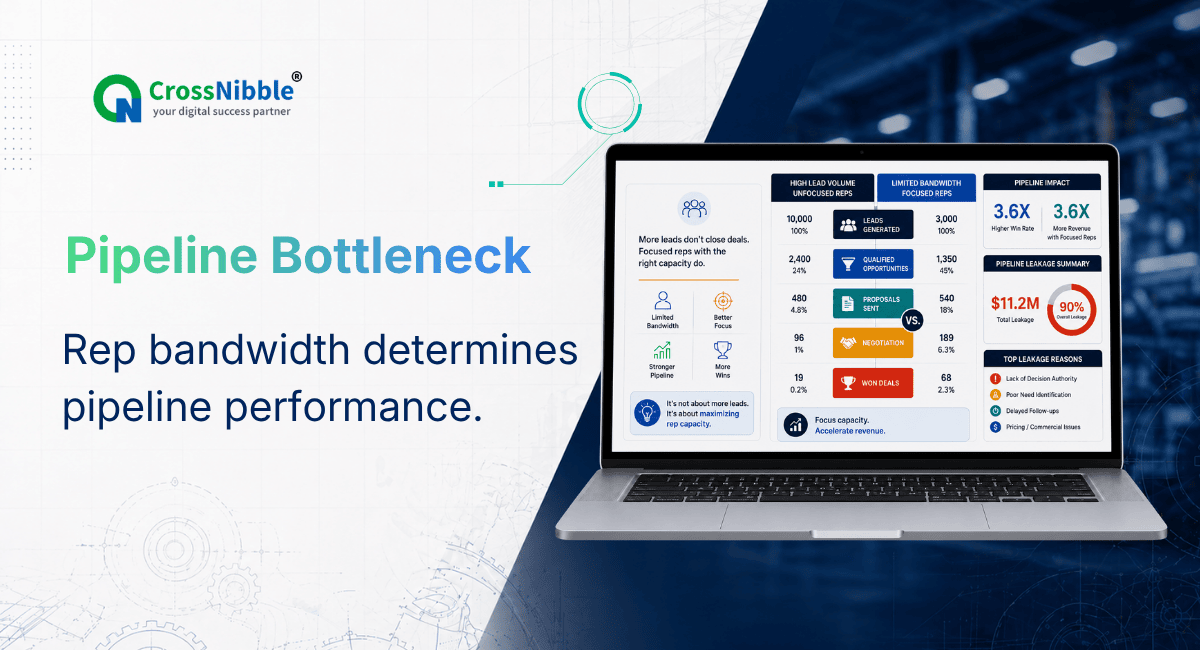
Sales planning conversations focus on lead supply. The implicit model is that more leads at the top mean more revenue at the bottom, constrained only by lead quality and rep skill. The model misses the actual constraint in most B2B teams: rep bandwidth.
Quick answer: Sales rep bandwidth is the maximum number of active opportunities a rep can multi-thread at the engagement level required to close B2B deals. Typical capacity is 15 to 25 active deals depending on cycle length. Above that, multi-threading collapses and win rate per deal drops sharply.
What is sales rep bandwidth in B2B?
Bandwidth is the finite capacity of a single rep to engage multiple stakeholders, run multi-threaded pursuits, and maintain weekly cadence across all of their active opportunities. It is not a measure of how many deals are in their CRM. It is a measure of how many deals they can actually move.
Most B2B reps have a bandwidth ceiling between 15 and 25 active opportunities. Above that, multi-threading collapses. The rep can keep deals warm but cannot drive engagement breadth on any of them. Their CRM shows 80 active deals. Their reality is 5.
Why is the lead-supply model wrong?
The model assumes capacity is elastic. It is not.
Adding more leads to a saturated rep does not add pipeline. It dilutes pipeline. There is a point above which generating more leads has zero marginal value. There is a further point above which it has negative marginal value because the team starts losing deals it would have won at lower volume.
How do you know if your reps are over-capacity?
Five signals.
- Rep owns more than 25 active opportunities at any given time
- More than 30 percent of their pipeline has not been engaged in the last 14 days
- Win rate has dropped despite no obvious skill or motivation issue
- Deal velocity has slowed compared to prior periods
- Rep complains about lead quality more than usual (often a coded complaint about volume)
What does the territory imbalance pattern look like?
The hardest version of bandwidth misallocation is when one rep owns five to ten times the contact load of any other rep on the team.
This is almost never a deliberate choice. It is the result of a default routing rule that fired thousands of times without anyone reviewing the cumulative effect. The rep is buried. The deals are dying. The dashboard reports a fully assigned territory.
Capping load is not a punishment of high-volume reps. It is a recognition that B2B revenue is built on engagement depth, and engagement depth requires bandwidth that gets crushed by overload.
How do you audit B2B sales bandwidth?
Three queries in your CRM, calculated per rep:
- Active record count: how many open opportunities does each rep own?
- Engagement rate: what percentage have been touched in the last 14 days?
- Win rate by load level: compare win rate when rep is under 20 active deals versus over 20
The third number tells you exactly how much potential output is being thrown away by your assignment rules.
How do you fix bandwidth misallocation?
Step 1: Cap active load per rep
Set a maximum of 20 to 25 active opportunities. Records over the cap go to a holding pool, not into a rep's queue.
Step 2: Redistribute existing load
Move surplus records to under-utilised reps. This may require pairing exercises or temporary territory shifts.
Step 3: Audit routing rules
Whichever default rule created the imbalance is still firing. Fix it before redistributing.
Step 4: Re-measure in 90 days
Track win rate, velocity, and rep retention. The improvements compound.
Key takeaways
- Sales rep bandwidth is finite, typically 15 to 25 active deals.
- More leads above that ceiling reduce pipeline output, not increase it.
- Territory imbalances are usually default routing rules nobody audited.
- The bandwidth audit is the first thing a new sales leader should run.